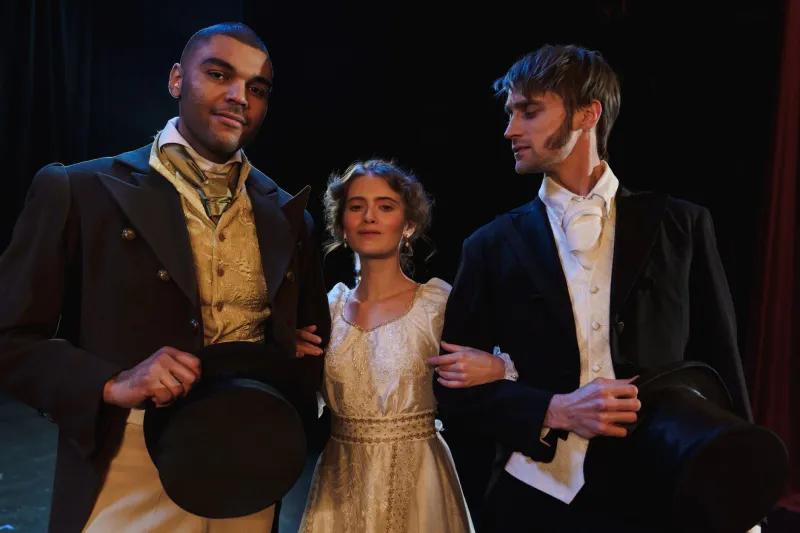
Bit Parts, Big Cheers: The Cameo Roles That Quietly Run Away With A Christmas Carol
Photo: engraving by Brothers Dalziel, Public domain, via Wikimedia Commons
There is a particular kind of joy in watching a stage full of Victorian London pause for a character who has wandered in for roughly ninety seconds. In A Christmas Carol, the giants do the heavy lifting: Scrooge, Marley, the ghosts, Tiny Tim. But the texture of the thing — the warmth, the comedy, the sense that this is a living city and not just a morality lecture with tinsel — comes from the bit parts. The laundress with a basket. The two men collecting for charity. The lad who is sent running for the biggest turkey in the shop.
Why directors treat tiny roles like gold
A Christmas Carol is an ensemble piece disguised as a one-man redemption story. Directors know that if the cameos are flat, the whole production feels like a school assembly. If they sparkle, the audience leans forward. These small roles do something structural: they give the story air. After a heavy scene with Marley's chain, a brisk exchange with a turkey boy can reset the room. After Scrooge's sneering, a charity collector's quiet dignity reminds us what is at stake.
They are also ruthlessly efficient. Dickens gives these figures just enough detail to be recognisable — a voice, a hat, a way of standing — and no more. That is a gift to an actor and a puzzle for a director. How much business do you add? When does a lovely little moment become a scene-stealing detour? The best productions walk that line with precision.
Mrs Dilber: the laundress with the last laugh
Mrs Dilber is a laundress, and in most adaptations she appears in the final stretch, selling Scrooge's belongings to a fence. She has few lines and a very specific job: to show us that a man can be erased while he is still alive. Played badly, she is a pantomime hag. Played well, she is genuinely unsettling — funny and grubby and human.
Actors who land Mrs Dilber tend to resist the urge to wink at the audience. The comedy comes from her practicality. She is not cackling; she is doing a transaction. The best Dilbers make you laugh and then make you feel slightly cold. In 2026, several UK productions are giving the role a little more room than usual, letting her exchange with the charwoman and the undertaker's man build into a proper trio of grave-robbing comedy before the Ghost of Christmas Yet to Come silences the room.
The charity collectors: masters of the awkward pause
The two gentlemen who ask Scrooge for a donation are often doubled with other roles, but they are never forgettable. Their function is to establish Scrooge's meanness in public, and their comedy comes from politeness under pressure. One is usually fuller, jollier; the other a little more hesitant. Together they create the perfect straight men for Scrooge's sneer.
What makes the scene work is the pause after Scrooge says something appalling. A good actor lets the silence sit just long enough for the audience to laugh, then pulls it back before it becomes uncomfortable. In 2026, watch for productions that give the collectors a small callback later in the evening — a nod in the Christmas morning scene, a coin in a hat — to close the loop. It is a tiny dramaturgical stitch, but it makes the story feel knitted together.
The turkey boy: sprinting into legend
The boy sent to buy the turkey is the cameo that can accidentally become the star of the show. He has one job: to run an errand for a newly reformed Scrooge, and to be delighted about it. That is it. And yet, in the wrong hands, the moment can be overplayed into a miniature Oliver Twist musical number. In the right hands, it is a burst of pure joy.
The best turkey boys are not cute; they are fast. They play the urgency of the errand, the wonder of a shilling, the fact that the poulterer's shop is probably about to close. The comedy comes from Scrooge being more excited than the boy. When the boy is allowed to be a real child — slightly out of breath, a bit confused, absolutely up for a sprint — the scene lands every time.
Other cameos worth watching
Keep an eye on Fezziwig's fiddler, who can turn a party scene from pleasant to euphoric with a single scrape of the bow. Martha Cratchit often gets a lovely little beat of arrival, and Topper — the young man at Fred's party — is a gift for a comic actor who can make being cheerful slightly desperate. Even the portly man who laughs at Scrooge's funeral is a tiny, necessary piece of the machine.
2026 productions turning minor figures into favourites
Several venues this year are leaning into the cameo economy. The Old Vic's 2026 staging gives Mrs Dilber a properly grubby comedy that sits beautifully against the chill of the final ghost. Nottingham Playhouse's production uses doubling so cleverly that the charity collectors reappear as carol singers, making the world feel small and connected. Leeds Playhouse has a turkey boy who practically steals the second half with a single sprint across the stage, and Shakespeare North Playhouse's in-the-round staging lets the audience see every flicker on the faces of the bit-part players.
Bristol Old Vic and Theatre by the Lake are also worth a look for the way they cast actor-musicians in cameo roles, so the charity collectors might also be the ones playing the fiddle. It is a reminder that in a good Christmas Carol, everyone on stage is doing at least two jobs, and the smallest parts are never small to the people playing them.
How actors make a cameo land
The secret is specificity. A cameo actor has no time to build a backstory, so they build a physical detail instead: a sniff, a way of holding a hat, a particular rhythm of speech. They listen properly to Scrooge rather than waiting for their line. And they trust the writing. Dickens gave these figures just enough, and the best actors resist adding a dozen extra mannerisms.
A great cameo is like a good Christmas cracker joke: brief, silly, and somehow essential to the meal. Get Mrs Dilber, the charity collectors and the turkey boy right, and the whole production feels richer. Get them wrong, and you can feel the audience checking their watches. In 2026, the smart money is on the bit parts.